 052 6146014 / 0818 333757

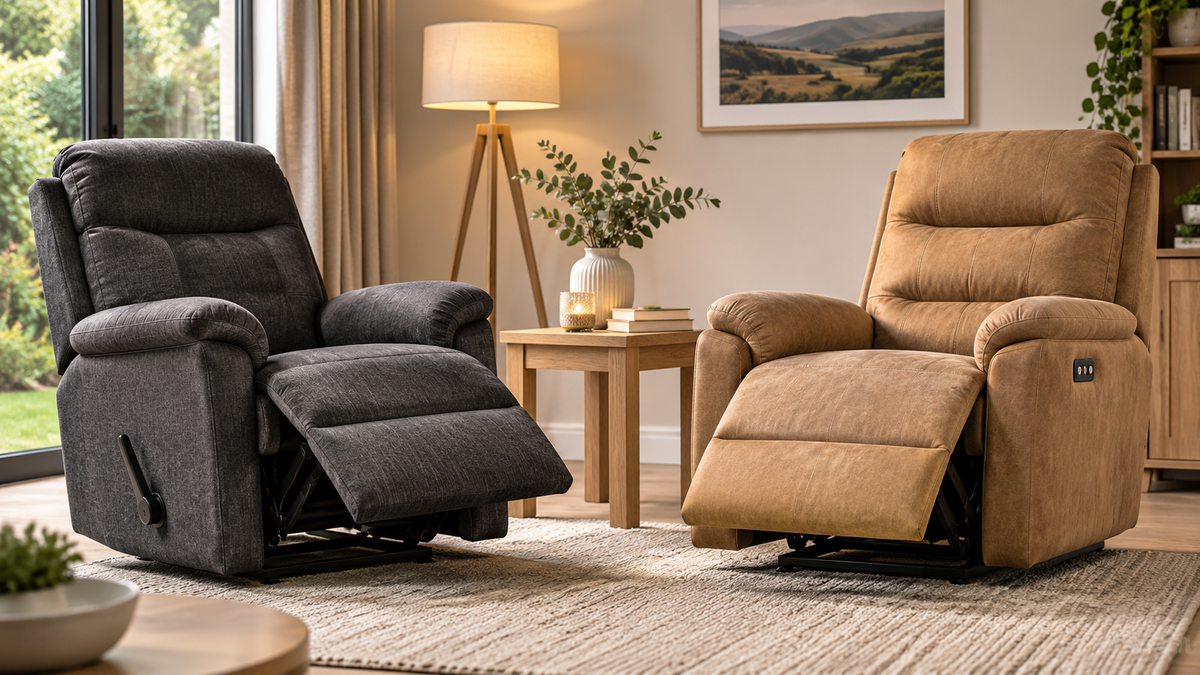
When evenings turn darker and more time is spent relaxing at home, a comfortable chair can make an enormous difference to how a sitting room works. But should you choose a manual recliner or an electric recliner? Both let you adjust your position; the important differences are the controls, the room you need, the available features and the way you actually use the furniture.
This buying guide is for Irish households comparing reclining armchairs and sofas, whether you are furnishing a compact sitting room, updating a family TV space or creating a comfortable corner for reading. Rather than declaring one type universally better, we will work through the practical questions that help you choose well.
Manual vs electric recliners: the quick comparison
| Consideration | Manual recliner | Electric recliner |
|---|---|---|
| Operation | Usually a lever, handle or push-back mechanism | Powered controls move the reclining components |
| Power supply | Generally none required | Usually needs a suitable electrical supply |
| Position adjustment | Depends on the model and mechanism | Often offers gradual powered adjustment |
| Placement | Consider reclining and walking clearance | Consider reclining clearance plus access to power |
| Maintenance | Check moving parts and upholstery | Also consider motors, controls and cables |
| Best fit | Shoppers favouring straightforward operation | Shoppers wanting powered operation and additional controls |
These are general distinctions, not promises about every product. Mechanisms, electrical functions and clearances differ significantly, so the individual listing and manufacturer's instructions take precedence.
How does a manual recliner work?
A manual reclining chair uses a mechanical action to reposition the backrest and footrest. Depending on the design, you may operate a handle, pull a lever or shift your weight against the back. The action can feel different from chair to chair, which is why it is worth checking how the particular model operates rather than relying on the word “manual”.
The straightforward appeal is that you do not normally need to arrange a nearby socket. This can make furniture placement more flexible in older homes where socket positions do not match the ideal seating layout.
Where manual recliners make sense
Manual models can be a sensible choice in a room used by several people, particularly when everyone is comfortable operating the mechanism. They are also worth considering if you want to avoid additional cables running behind the furniture. For a concrete example of a manual option, see the Casey reclining armchair range, which the current Homeline listing describes as having manual reclining action.
Remember that manual does not necessarily mean lightweight or easy to operate for everyone. If somebody finds levers, grip movements or pushing back difficult, assess that before ordering.
How does an electric recliner work?
An electric, or powered, recliner uses motorised controls to move the reclining components. The experience can be more gradual than on some manual designs. However, not every powered chair has the same range of movement, number of motors or operating features.
For instance, Homeline's Cadenza charcoal electric recliner armchair listing describes a powered reclining action and USB charging ports. The Leroy powered armchair is another example to compare, with its own dimensions and upholstery choices. These products illustrate how styling and specifications vary within the same broad category.
Consider the location of the socket
Plan where the power lead will run before deciding on the chair's position. Avoid trapping cables beneath feet or the mechanism, and follow the manufacturer's electrical and safety instructions. A socket on the other side of a frequently used walkway is not an ideal starting point. The electrical setup should be practical as well as visually tidy.
How much room does a recliner need?
This is often the most overlooked buying question. A recliner is not just the width and depth printed on its product page when upright. You need to account for its position when extended, its distance from nearby walls and the route people take through the room.
Measure more than the chair footprint
Start with the product's full external dimensions. Mark that footprint on the floor with masking tape or pieces of paper. Then check the manufacturer's required reclining clearance. You will also need space to enter and exit the seat comfortably, reach a side table and move past without stepping over an extended footrest.
Do not assume every recliner must sit a fixed distance from the wall. Some designs are made to recline in a smaller clearance than others. Equally, a compact upright depth does not guarantee a compact extended depth. Ask for the exact measurements if they are missing from a listing.
Think about your sitting room layout
For smaller rooms, a single chair may work better than an entire reclining suite. Compare the available recliner armchairs and map the preferred position against doors, radiators, windows and existing furniture. Keep access routes open and avoid crowding a heat source.
Should you choose a reclining armchair or a reclining sofa?
A single recliner gives one person a dedicated place to sit and can be positioned independently from the main sofa. This is useful where the room has an awkward corner or you want to keep the central seating arrangement unchanged.
A reclining sofa may be more suitable if two or more people regularly want the option to stretch out. For example, Homeline currently lists a Cadenza two-seater electric reclining sofa and a Cadenza three-seater electric reclining sofa. Check their widths and the reclining positions included on the selected model: being described as a three-seater does not automatically mean all three seats recline.
For family rooms, the best arrangement can be a fixed sofa paired with one recliner, rather than replacing every seat with a reclining version. Think about where people watch television, where conversation naturally happens and whether a coffee table can still be reached.
Fabric or leather-look upholstery: what should you consider?
The covering affects both appearance and day-to-day care. Fabric can introduce softness and texture, while leather or leather-look finishes may suit a different design scheme. There is no one material that automatically performs best in every household.
Read the exact upholstery description. Terms such as leather, half-leather, bonded leather, leatherette and faux leather refer to different materials and should not be treated as interchangeable. Check the maker's cleaning guidance before using any household products, especially on coated finishes.
Comfort goes beyond the outer fabric
Seat depth, back height, arm position and cushion construction affect the way a chair feels. A high back may suit someone who likes head support, while another person might prefer a slightly shallower seat. Even when two products appear similar online, their proportions can make them feel different in use.
Homeline's wider fabric sofa and armchair range is useful for comparing textures and silhouettes alongside reclining options.
Are electric recliners worth paying more for?
The answer depends on which features matter to you. A powered mechanism can be appealing if you value controlled adjustment and dislike operating a manual release. However, you are also purchasing electrical components that need appropriate use and may require service over time.
Compare the actual specification rather than assuming powered automatically means premium. Look at the seat construction, dimensions, upholstery, controls, warranty and what happens if power is interrupted. Any USB charging function should be treated as a product-specific convenience, not a standard feature across all electric recliners.
Recliners are not the same as lift-and-rise chairs
Some motorised chairs are designed to tilt or raise the seat to assist standing. That is a distinct feature and must not be assumed from the word “electric”. If standing assistance is an important requirement, compare the dedicated powered occasional and lift-and-rise chair collection and check the stated function of each model. For mobility-related needs, appropriate professional advice and a suitable personal fit may also be important.
How to compare recliner prices fairly
A lower advertised price does not establish better value. Compare like for like: one armchair against another armchair, or a two-seater sofa against another two-seater with the same reclining-seat configuration. Make sure you know whether the price covers a single chair, a whole sofa or a suite.
Next, check the features you will actually use. Are you paying for motorisation, additional controls, a particular upholstery material or simply a larger frame? Compare each selected product's specifications rather than making assumptions from promotional photographs.
You can see both styles together in Homeline's recliner sofas and armchairs collection. Confirm current variant details, availability and delivery information on the product page before purchasing; these can change.
Our recliner buying checklist
- Measure: width, depth, height and full reclining clearance.
- Choose the mechanism: manual action, powered adjustment or a separately specified rise function.
- Check access: doorways, stairs, room circulation and the path to the final position.
- Confirm the power setup: if electric, identify a safe and suitable socket location.
- Compare comfort: seat depth, arm height, back support and the intended user's preferences.
- Verify the exact listing: colour, number of reclining seats, upholstery, assembly instructions and warranty.
If the room already has a sofa you like, there is no need to replace it merely to add one reclining seat. Browse the broader armchair collection as well and judge the new piece in the context of your existing furniture.
Frequently asked questions
What is the main difference between manual and electric recliners?
Manual recliners use a mechanical action, while electric recliners use powered controls. The precise mechanism and available positions depend on the individual model.
Do electric recliner chairs have to be plugged in?
Many require mains power, but always check the particular product's power requirements and instructions. Do not assume a battery option is included.
Can a recliner go against a wall?
Some designs allow relatively close positioning; others need substantial clearance. Always use the manufacturer's required space rather than a general rule of thumb.
Is a power recliner the same as a lift-and-rise chair?
No. Powered reclining and standing assistance are separate functions. Choose a chair specifically described as lift-and-rise if that feature is required.
Is a recliner suitable for a small Irish sitting room?
It can be, especially as a single chair, provided the full extended footprint and walking routes fit the room. Make a floor plan before ordering.
Which recliner is best for a family home?
Choose based on who will use it, how often they will recline, the practical space and the upholstery-care requirements. There is no universal best model for every family.
Ready to compare? Start with your room measurements and your preferred operating mechanism, then review the verified options at Homeline Furniture before choosing your chair or sofa.